Modest wedding guest dresses cover the shoulders, keep the neckline high enough and fall at or below the knee, without giving up on elegance. They are the natural choice for many religious ceremonies and cultural weddings, and plenty of guests simply prefer them for comfort and style.
Expectations vary a lot from one faith, family and community to another, so this guide gives general principles, then covers the questions that come up most often for church weddings, Muslim weddings, Indian weddings and other celebrations. When a detail really matters, the couple or their family is always the best source.
What makes a wedding guest dress modest
“Modest” is not a single rule, but most definitions share the same core elements.
- Shoulders covered by a sleeve, a cap sleeve or a layer such as a bolero or shawl.
- A neckline without deep plunge: crew, boat, high V, keyhole or collar necklines all work.
- A hemline at or below the knee, with midi and maxi lengths as the easiest options.
- Opaque fabrics, or sheer fabrics with a full lining underneath.
- A fit that skims rather than clings. A-line, empire, wrap and flowing maxi shapes are more modest than bodycon styles.
Within those limits, you can still wear color, prints, embellishment and luxurious fabrics. Modest does not mean plain.
Cuts and details that feel elegant and covered
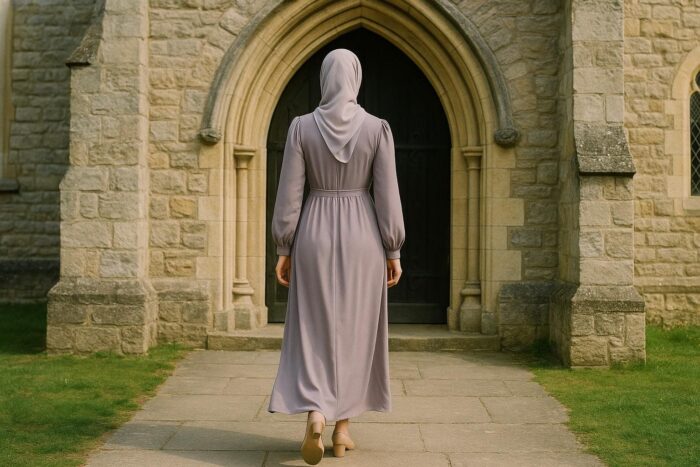
- Long-sleeve maxi dresses in chiffon, crepe or satin look formal and provide full coverage.
- Midi dresses with flutter or elbow sleeves suit daytime and cocktail weddings.
- Dresses with sheer sleeves over a lined bodice keep a light, dressy feel while covering the arms.
- High-neck or cape details add drama for formal evening events.
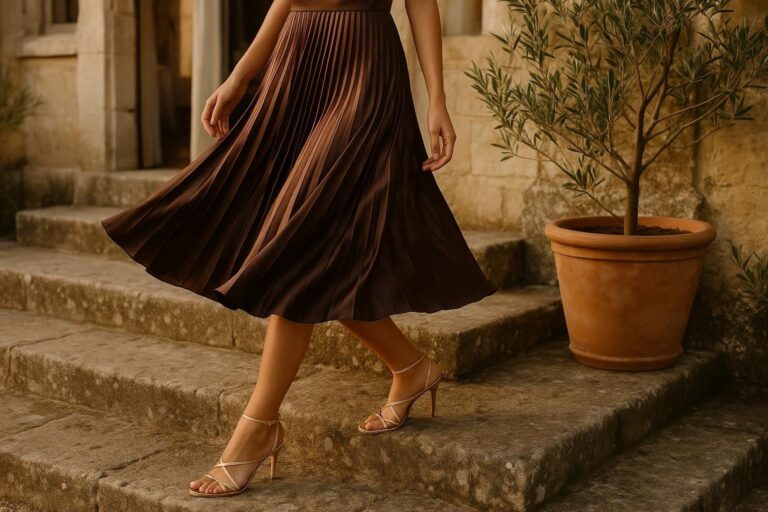
- Pleated skirts move beautifully and stay modest when you sit or dance.
- Layering pieces such as a matching jacket, a bolero or a large wrap let you adapt a dress that is slightly too open.
For advice on dress codes, fabrics and silhouettes that applies to every guest, our guide to choosing the perfect outfit for any celebration goes into more detail.
What to wear to a church wedding
Many Christian churches in the US do not enforce a formal dress rule for guests, but respectful clothing is expected, and some congregations or clergy are stricter than others.
- Catholic weddings: covered shoulders and a knee-length or longer hem are a safe standard for the ceremony. A shawl or jacket over a sleeveless dress is usually enough.
- Greek Orthodox weddings: shoulders are generally expected to be covered during the church service, and some churches are stricter than others. Low necklines are best avoided. You can remove the wrap or jacket at the reception.
- Other denominations: the same principles work well. Look at the church’s website or ask the couple if you are unsure.
Keep the layer on for the whole ceremony rather than slipping it off halfway through, and choose one that matches your dress so it looks intentional.
What to wear to a Muslim wedding
Dress expectations at Muslim weddings vary widely with the couple’s culture and family. As a general guide, female guests are expected to dress conservatively, covering the arms, legs and chest with loose-fitting clothes.
- Good choices: long-sleeve maxi dresses with a high neckline, an elegant abaya, a kaftan, or a long skirt with a long-sleeve top. South Asian families often welcome festive outfits such as a saree or a salwar kameez, worn modestly.
- Head covering: bring a scarf. You may be asked to cover your hair, especially if any part of the celebration takes place in a mosque.
- To avoid: short hemlines, sleeveless and strapless dresses, sheer fabrics without lining, very tight silhouettes, and all-white outfits.
Some celebrations separate men and women for part or all of the event. In women-only spaces, guests may dress more glamorously, but it is wise to arrive covered.
What to wear to an Indian wedding as a guest
Indian weddings often include several events over one or more days, such as a mehndi, a sangeet, the ceremony and a reception. Each can have its own dress code, so check the schedule and the couple’s website.
- Colors: bright and jewel tones are welcome: emerald, royal blue, pink, teal, gold and orange. Avoid white and black, which are associated with mourning or considered inauspicious in many traditions, and avoid bridal red.
- Traditional outfits: a saree, a lehenga or an anarkali is often appreciated if the couple has invited guests to wear Indian attire. If you are unsure how to wear one, ask for help or choose a simpler anarkali.
- Western options: a colorful maxi dress with sleeves or a festive jumpsuit is generally accepted if you prefer not to wear Indian attire.
- Coverage: for temple or gurdwara ceremonies, cover your shoulders and legs, and bring a scarf in case you need to cover your head. Shoes are often removed in temples and gurdwaras, so choose a pair that slips on and off easily.
Rules on black are loosening at some modern sangeet or reception events, but it remains a color to avoid unless the couple says otherwise.
What to wear to a Mexican wedding
Many Mexican weddings include a Catholic church ceremony followed by a long, lively reception. Plan for both.
- For the ceremony, choose a dress that covers the shoulders, or bring a wrap or jacket.
- Color is welcome: jewel tones, florals and festive prints feel right. Avoid white, and consider avoiding all-black at the ceremony, since some families still associate it with mourning.
- Receptions often run late with a lot of dancing, so comfortable shoes and a dress you can move in are practical.
How to adapt a dress you already own
You do not always need to buy a new modest dress. A few simple additions can make an existing one appropriate for a religious ceremony.
- Add a layer. A tailored jacket, a cropped cardigan, a bolero or a large pashmina covers shoulders and arms. Choose one in the same color family as the dress so it looks planned.
- Wear a slip or camisole. A silk camisole under a wrap dress raises the neckline; a full-length slip under a sheer skirt adds opacity.
- Choose longer lengths. A midi dress that sits just below the knee when standing can ride up when seated, so check it in a chair before the day.
- Add sheer tights. For some conservative ceremonies, tights with a knee-length dress feel more appropriate than bare legs.
- Keep accessories refined. A structured bag and simple jewelry keep the focus on elegance rather than on skin.
Quick reference by ceremony type
| Wedding type | Coverage to plan for | Colors to avoid |
|---|---|---|
| Catholic church | Shoulders covered, knee-length or longer | White and ivory |
| Greek Orthodox | Shoulders covered in church, no deep necklines | White and ivory |
| Muslim | Arms, legs and chest covered, scarf on hand | All-white outfits |
| Hindu or Sikh (Indian) | Shoulders and legs covered in temple or gurdwara, scarf on hand | White, black, bridal red |
| Mexican (church ceremony) | Shoulders covered for the ceremony | White; all-black at the ceremony |
These are general tendencies. Individual families and communities may follow different customs, so treat the couple’s guidance as the final word.
FAQ
What is considered a modest wedding guest dress?
A dress that covers the shoulders, avoids deep necklines, falls at or below the knee and is not sheer or skin-tight. Midi and maxi dresses with sleeves are the easiest options.
Do I need to cover my shoulders at a church wedding?
It depends on the church, but covering your shoulders is the safest choice, particularly at Catholic and Orthodox ceremonies. A shawl or jacket over a sleeveless dress works well.
Can I wear Western clothes to an Indian wedding?
Yes, a colorful, modest dress or jumpsuit is generally accepted. If the couple invites guests to wear Indian attire, a saree, lehenga or anarkali is a thoughtful choice.
Should I bring a scarf to a religious wedding?
It is a good idea. A scarf lets you cover your shoulders or your hair quickly if the place of worship requires it.